Hard Top vs Pop Top Caravan — Which Is Right for Australian Touring?
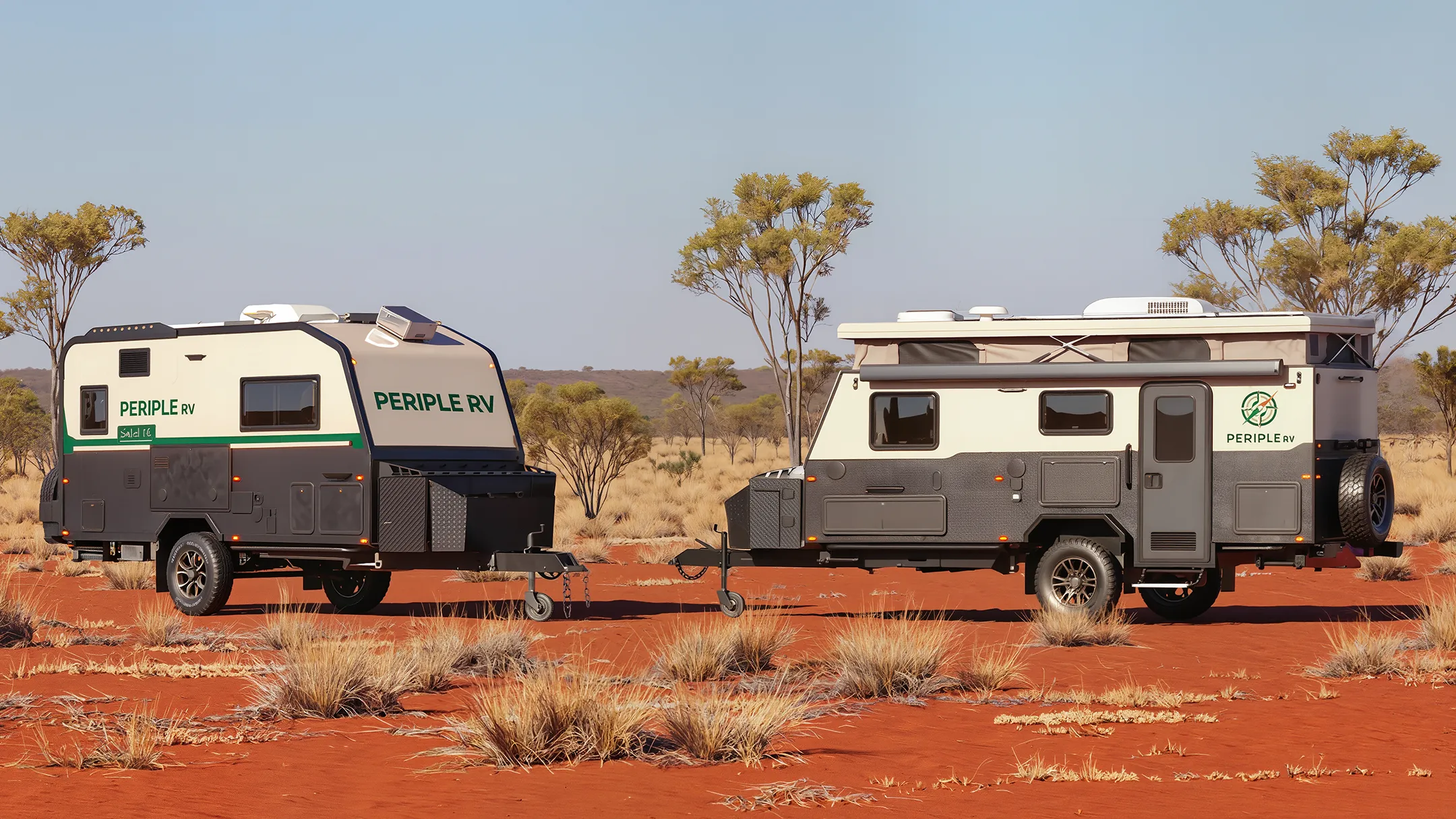
The definitive answer — and how the Periple 16 Solid and Periple 16 Aero sit on opposite sides of that decision.
If you're researching the Periple 16 Solid and wondering whether the Periple 16 Aero — our pop top model — might be the smarter buy for your situation, you're asking exactly the right question. Lower tow profile, fit, potentially lighter on the tow vehicle. These are real advantages and we're not going to dismiss them.
But we're also not going to pretend the two vans are interchangeable. They're built on the same fibreglass composite platform, they share the same build philosophy, and they're both serious products. What they offer is genuinely different — and which one is right for you depends entirely on how and where you tour.
This article gives you the full picture: the history of both designs, an honest comparison of advantages and trade-offs, and a clear explanation of where each Periple model sits in that picture. No spin. Just the information you need to make the right call.
The Hard Top Caravan — 80 Years of Getting It Right
The fixed-roof caravan is as old as recreational touring in Australia. When families first hitched purpose-built vans behind their cars in the 1920s and 30s, those rigs were hard-topped by default — there was no alternative. Timber frames, canvas walls, corrugated iron. Rough as guts, but they got Australians to the coast and back.
From Tin to Composite
1940s – 1950s
Post-war prosperity and better roads drove a genuine caravan boom. Manufacturers like Windsor, Viscount, and Millard established themselves. Aluminium cladding replaced timber and canvas — lighter and more weather-resistant, better suited to the corrugations out past the black stump.
1960s – 1970s
The hard top matured into a proper family product — gas cookers, running water, real beds. It became synonymous with the great Australian family holiday. The Grampians, the Flinders Ranges, up the Queensland coast. The roof was just the roof; nobody questioned it.
1980s – 1990s
Fibreglass composite panels started replacing aluminium-over-timber construction. Better insulation, less maintenance, smoother profiles. The hard top began to look genuinely modern.
2000s – 2010s
The off-road segment exploded. Australians wanted the Gibb River Road, the Oodnadatta Track, Cape York. Hard tops on independent suspension with heavy-duty chassis became the obvious choice. Serious investment flowed into composite construction and structural engineering across the industry.
2015 – Present
Full fibreglass composite monocoque construction — where walls and roof are a single bonded structure — became the premium benchmark. Lighter, stiffer, better insulated, and dramatically more waterproof than anything aluminium-framed. This is the construction the Periple 16 Solid is built on.
The Pop Top Caravan — A History of Clever Compromise
The pop top was born from a specific problem: towing height. Early family cars struggled to pull a full-height van at highway speeds without being pushed around by crosswinds and burning fuel at a frightening clip. Lower the roofline on the road, raise it at camp — clever idea, and it caught on fast.
From Canvas to Composite
1950s – 1960s
Pop tops emerged in Europe and North America before reaching Australia. Canvas-sided upper sections on simple mechanical cranks. Light, affordable, and immediately popular with buyers who couldn't stretch to a full-height van. Many young Australian families towed them behind Holdens and Falcons for decades.
1970s – 1980s
Australian manufacturers embraced the format. The pop top settled into the budget tier — a starter van for cost-conscious buyers. Canvas sides meant great ventilation but always a negotiation with the weather.
1990s – 2000s
Fibreglass-reinforced PVC replaced canvas on better models. Gas-strut lift systems made raising the roof a one-person job. Pop tops began to shed some of their budget stigma at the premium end of the range.
2010s
A second wave of engineering arrived. Solid fibreglass panels on the raised section replaced flexible materials in premium models. Multi-point latching, proper perimeter gaskets, reinforced roof frames. Pop tops started competing in mid-range price brackets.
2020s – Present
Premium pop tops today — including the Periple 16 Aero — use composite panels, precision-engineered lift systems, and multi-seal perimeter gaskets. They cost considerably more to engineer and manufacture than the canvas-sided vans of forty years ago. The "cheap pop top" narrative is well past its use-by date.
Head to Head — The Honest Comparison
Hard Top (Periple 16 Solid)
What You Get:
- Fixed, load-bearing roof — the shell is structurally complete and rigid
- No perimeter seal between you and the rain — dramatically lower leak risk
- Fully foam-cored roof panels throughout — superior insulation in heat and cold
- Maximum solar real estate — large, flat, uninterrupted roof surface
- No lift mechanism to service, fail, or eventually replace
- Roof racks, aerials, and accessories bolt straight on without compromise
The Trade-offs:
- Higher tow profile increases wind drag and crosswind sensitivity
- Slightly heavier on the road than the Aero at the same footprint
Pop Top (Periple 16 Aero)
What You Get:
- Lower tow profile — reduced drag and better highway stability
- Natural ventilation when raised — genuinely valuable in tropical Australia
- Lighter on-road weight than the Solid in equivalent configuration
- Same fibreglass composite walls and floor construction as the Solid
The Trade-offs:
- Perimeter seal is a potential failure point — requires annual inspection
- Lift mechanism requires periodic servicing and has a finite lifespan
- Roof section insulation is reduced compared to the Solid's foam-cored panels
- Slightly reduced structural rigidity in the roof section vs a full monocoque
- Must be lowered before towing — an extra step that genuinely matters
The Myth We Need to Address
Common myth: "Pop tops are simpler and cheaper to build — so they must be the budget option."
That was broadly true in 1985. It is not true in 2026 — and it's not true of the Periple 16 Aero.
Building a properly engineered pop top today is genuinely demanding work. The lift mechanism must operate reliably under Australian conditions: salt air on the coast, corrugated tracks in the NT and WA, tropical humidity in Far North Queensland, and UV radiation that degrades polymers faster than almost anywhere else on earth. The perimeter seal between the raised section and the van body must remain watertight after thousands of open-close cycles across years of touring. The composite panels on the raised section must handle significant wind loading if the van is driven with the roof up — which happens.
A premium pop top like the Periple 16 Aero costs nearly as much to engineer and manufacture as the Solid. The material savings are absorbed by the mechanical complexity required to do it properly.
What this means for buyers: the Aero is not a cheaper version of the Solid. It's a different product built for a different kind of tourer. If you're choosing the Aero because it fits your travel and suits your tow vehicle, that's a well-reasoned decision. If you're choosing it because you assume it's simpler or more affordable, that assumption needs revisiting.
And if you ever come across a cheap pop top from another manufacturer and wonder why it's priced so much lower: the answer is usually that the sealing system, the lift mechanism, or the panel construction has been compromised. An under-engineered pop top 600 kilometres from the nearest town is not a minor inconvenience.
The Periple 16 Solid vs The Periple 16 Aero — Which One Is Yours?
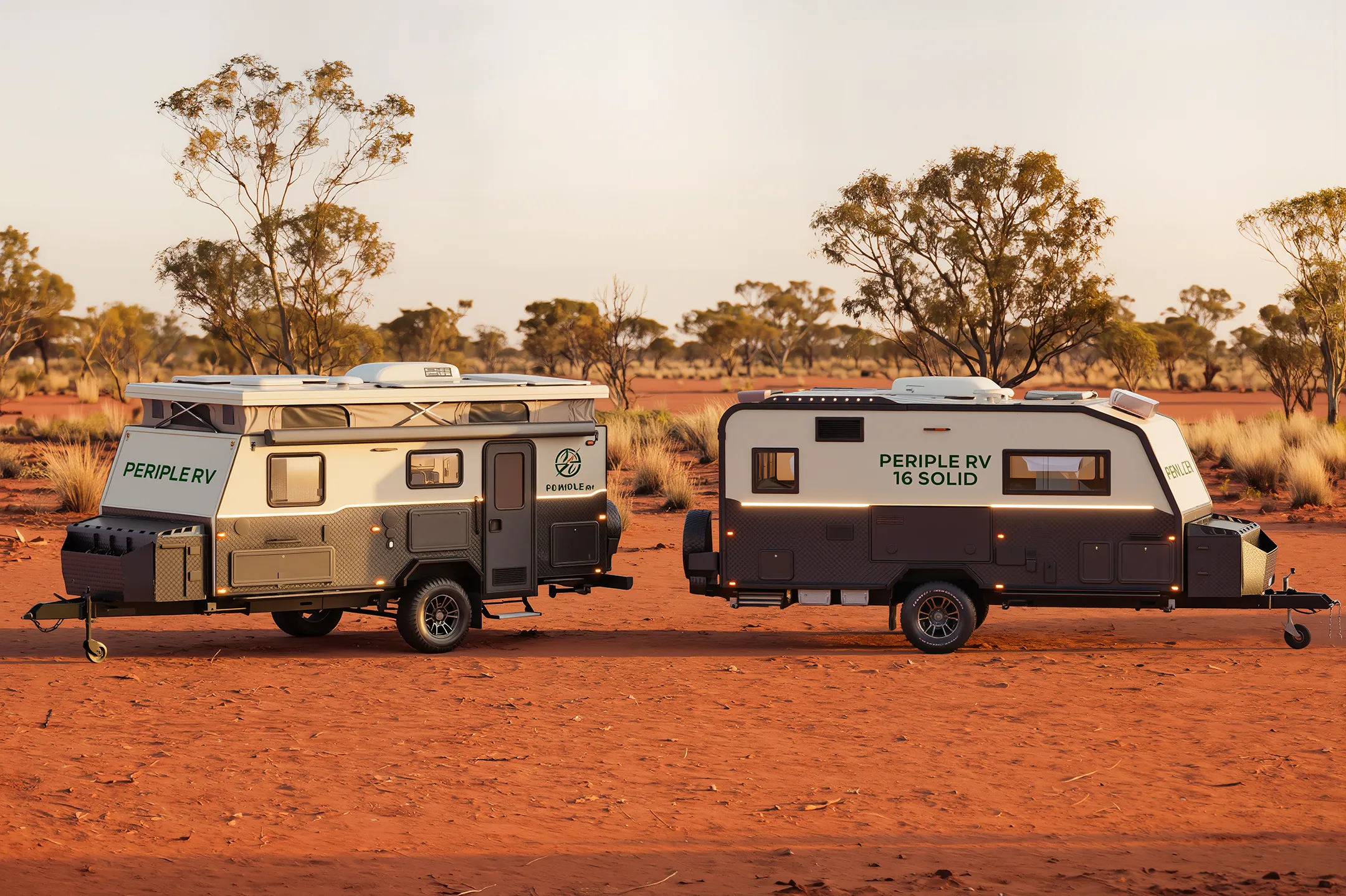
Both models are built on Periple's full fibreglass composite platform. Both share the same walls, the same floor construction, the same chassis engineering, and the same commitment to genuine off-road capability. The difference is the roof — and everything that flows from it.
Choose the Periple 16 Solid if:
- You plan to tour off-road — corrugated tracks, remote outback, Cape York, the Kimberley
- Off-grid solar is central to how you camp — you need maximum roof real estate
- You tour in temperature extremes — the Pilbara in summer, the Highlands in winter
- You want the lowest possible long-term maintenance — no mechanism to worry about
- You want the most structurally rigid 16-foot van Periple builds
Choose the Periple 16 Aero if:
- Your tow vehicle is at or near its rated capacity — the lower profile and lighter weight matter
- You tour primarily in tropical northern Australia where ventilation trumps insulation
- Highway fuel efficiency is a genuine priority for your setup
- You understand the annual seal inspection and mechanism servicing commitment
- You want pop top convenience with fibreglass composite construction underneath
The Honest Verdict
For most Australian tourers — particularly those heading off-road, going off-grid, or tackling remote destinations — the Periple 16 Solid is the stronger all-round choice. The fixed roof, the superior insulation, the maximum solar capacity, and the absence of any mechanical lift system add up to a van that does more with less to go wrong.
The Periple 16 Aero is not a compromise. It's a genuinely engineered pop top built on the same platform as the Solid, designed for buyers who have a real reason to choose a pop top — tow vehicle limits, or a preference for the ventilation of a raised section on tropical nights. If any of those apply to you, the Aero deserves serious consideration.
What both vans share is fibreglass composite construction throughout, serious off-road capability, and Periple's build standards. You're not trading down when you choose either one. You're choosing the configuration that fits your touring life.
Ready to choose your Periple?
The Periple 16 Solid (hard top) and Periple 16 Aero (pop top) — both built on the same fibreglass composite platform, designed for different tourers.
Found This Guide Helpful?
We put a lot of work into keeping this guide accurate, practical, and free of fluff. If it's been useful to you, please share it — but when you do, we'd appreciate a link back to the original article on the Periple RV website.
Linking back to the source helps other buyers find accurate, manufacturer-independent advice — and it keeps us motivated to keep writing content worth reading. Thank you.
Article Tags